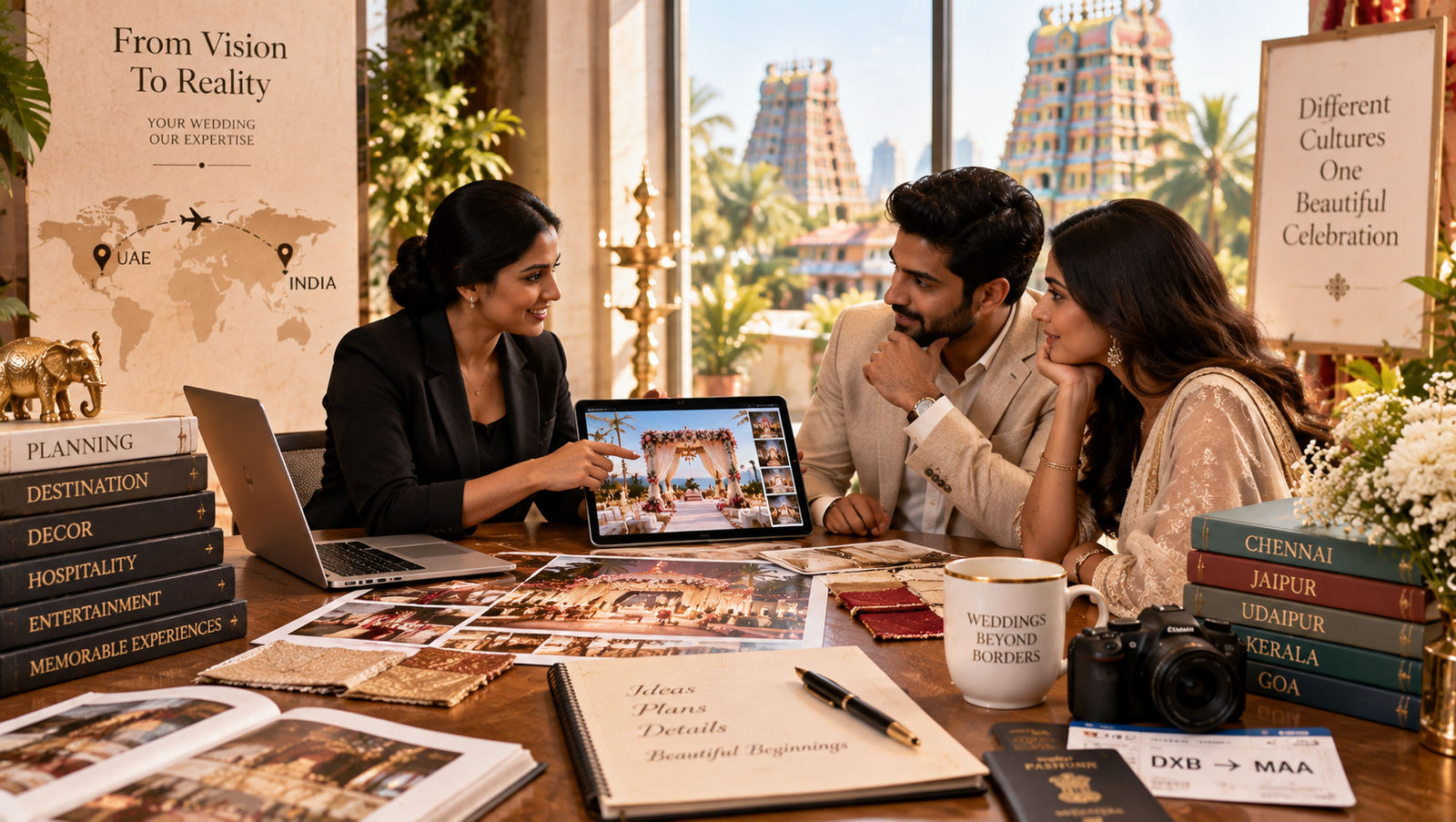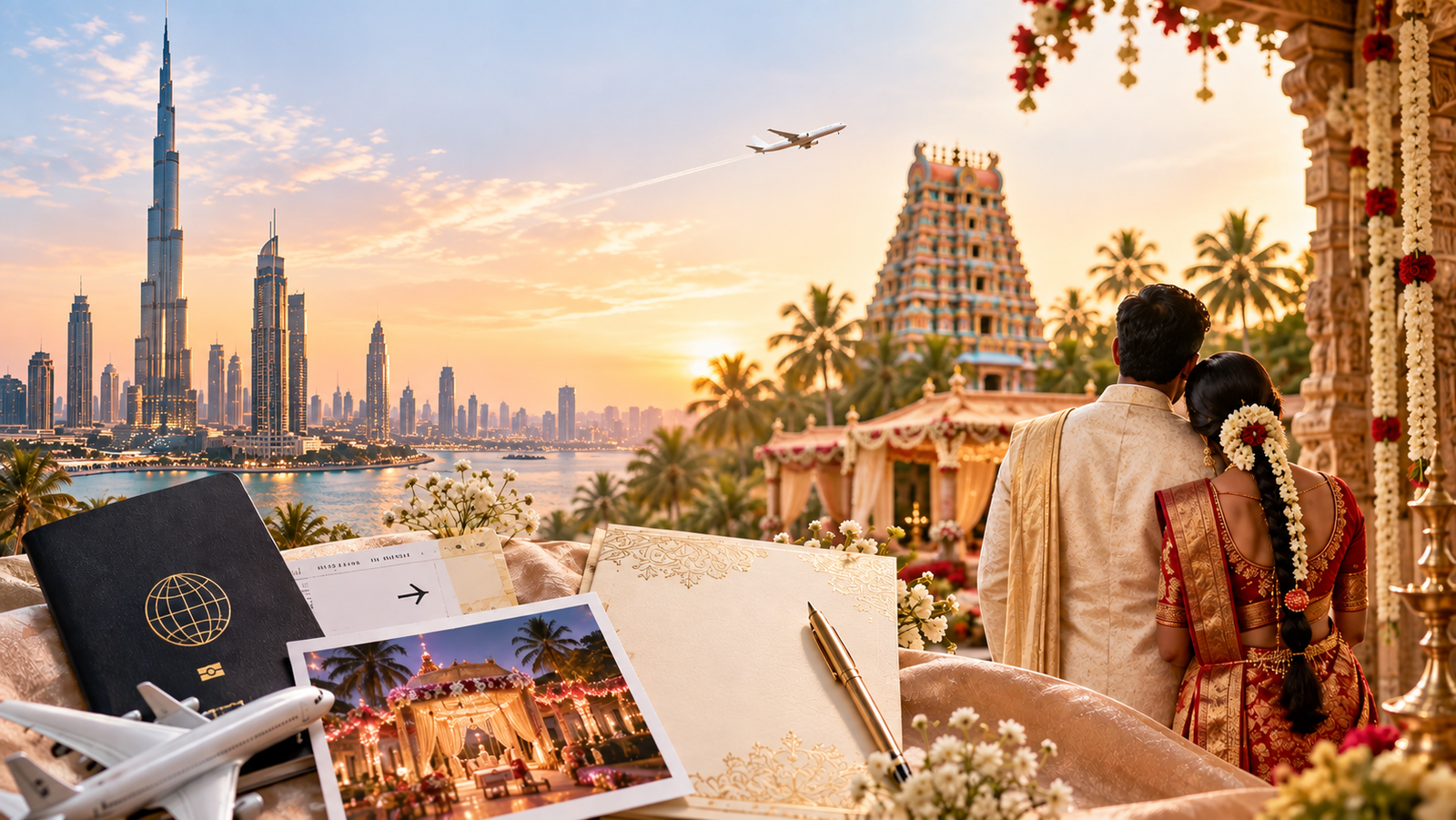
For families in the UAE, deciding on the destination for an Indian wedding can start with an innocent-sounding question. While Dubai is home for many UAE NRIs, India is where a wedding feels most fitting, with extended family, familiar rituals, regional cuisine, intergenerational traditions and the people who have waited years to see them united in matrimony.
The challenge is not in choosing India. It is in managing India from abroad. While a couple based in Dubai may have a picture-perfect idea of how their Indian wedding should look, there are numerous practical details that require someone to be present in India. From viewing a wedding venue in Chennai or finalizing décor in Jaipur to tasting menus with caterers and calculating travel logistics for guests, there are hundreds of tasks that must be completed before the big day arrives. Which is why, for NRI wedding planners in India, services to be truly effective, the central challenge is not whether a wedding can be planned abroad, but how planning can be tied to execution in real time.
In this regard, the UAE-to-India model becomes particularly appealing, wherein families can discuss budgets, themes, and requirements in detail with wedding planners in Dubai, while the actual wedding planning process takes place in India. From venue selection and site inspection to décor, catering, entertainment, and guest coordination, everything occurs on the ground so that an NRI family is not left with the task of choosing between participating in the planning of their dream wedding and being present at the wedding itself. At Oh Yes Events, a luxury event management company based in Chennai, this approach of
cross-border wedding planning helps connect clients to their dream wedding in India without losing sight of the role that family members based in the UAE can play in the process. The result is a personal yet professional approach to Indian weddings for NRI clients, who can rely on their wedding planners in Dubai to handle the details while remaining deeply involved in the bigger picture.
When you are planning from abroad, it is easy to begin with the obvious: the venue, the décor, the outfits and the flowers. But a wedding is much easier to control when the decisions underneath these details are made first. Your personal style, priorities, traditions and guest experience should have been established before vendors begin to turn individual ideas into individual quotations.
Begin by defining what you would want the celebration to feel like. A modern Indian wedding may take the subtlety of floral installations, contemporary stationery and refined tablescapes to pair with traditional ceremonies. A heritage wedding may be leaning into architecture, regional craftsmanship, textiles and historic settings. A couple with an international background might want a fusion Indian wedding, bringing together elements of two cultures without one being a token addition. An Indian wedding does not have to look traditionally Indian from start to finish. A modern Indian wedding can be as culturally rich as long as it uses a more restrained visual language. The important thing is consistency. If the couple's idea of luxury is quiet and considered, every decision from invitations and lighting to the mandap and table décor should reflect that.
The beauty of an Indian wedding lies partly in its abundance. There are ceremonies, rituals, meals, music and customs to choose from, many of which carry meanings your families have safeguarded across generations. But an NRI couple does not necessarily have to recreate every ritual they have ever heard. Identify the Indian wedding rituals that genuinely matter to you and your families. It could be the mehendi, haldi, sangeet, baraat or the wedding ceremony itself. Depending on your community and family background, there may also be regional customs that are particularly meaningful. Knowing the meaning behind Indian wedding customs can help couples make thoughtful choices rather than reproducing traditions for their presence in photos. This is especially important for couples in a cross-cultural wedding. When two cultural backgrounds meet, the ceremony can be an opportunity to explain, adapt, and celebrate both rather than treating one as an accessory to the other.
Once the general direction has been established, create a short list of what absolutely matters. It could be an intimate guest list, exceptional food, a particular venue, live entertainment, elaborate Indian wedding décor, or ensuring every visiting guest receives exceptional hospitality. It could be a priority to take photography seriously or create an immersive cultural wedding experience for relatives who have travelled from overseas. Whatever the priorities are, write them down before the planning gets crowded with other people's opinions. This list becomes particularly invaluable when dealing with NRI wedding planning in India from abroad. It gives your planner a clear understanding of where to protect the vision, where to offer alternatives, and where flexibility is possible. A well-defined vision does more than make the wedding look cohesive. It gives every decision a reason, and that makes the rest of the planning considerably easier.

Once you've decided on what the wedding should entail, you must choose where it will take place. For NRI couples, this often means selecting a venue that works for international travel, family logistics, accommodation, weather, and the overall experience of ceremonies and the guest experience. This can make all the difference in making a wedding seamless; a poor choice of destination, however, can cause otherwise picture-perfect weddings to become unnecessarily stressful.
The most logical consideration should be what ease of access the location provides to your guests. For an NRI wedding, particularly one that would see guests from other countries, this can be the defining characteristic that should shape the choice of both destination and venue. This can include, among other things, the availability of transport, domestic connections, transfers, local transport and the distances between places of stay. This consideration often gets overlooked for grand weddings, particularly when a guest list is expected to be largely of fellow countrymen or senior citizens. However, a location that involves long-distance or multifaceted transportation can prove to be stressful for those unfamiliar with Indian geography. The best destination wedding in India, therefore, is not necessarily one at the most inaccessible or exotic of locations, but rather the one that accommodates the needs of the people who visit it to celebrate your wedding.
The venue should also support the requirements of the wedding. Luxury hotels can be an option to consider for their ability to offer accommodation, catering, and event management services in one place, whereas resorts might be able to offer a more immersive experience, particularly when multiple days are being considered for a wedding celebration. Heritage properties can offer authenticity without requiring much to be done to them, while private venues may offer greater flexibility in production design. What your wedding requires should decide what type of venue you choose. A multi-day destination wedding with several hundred attendees will have vastly differing requirements as compared to a small private ceremony followed by an exclusive dinner for two. Your destination wedding planning for NRI couples should therefore consider, alongside aesthetic appeal, the capacity in terms of people, power backup, kitchens, parking, production setup and space, and weather considerations.
An NRI wedding is unlikely to involve just one location and function. Families and friends often travel in extended groups and require a number of functions to be hosted in the same vicinity. This could include a welcome dinner, mehendi or haldi, sangeet, wedding ceremony and reception. This is where destination planning can become significantly more involved, as it requires looking into the local logistics of transport and amenities in addition to the venue and its capabilities. A location such as Chennai can be particularly helpful in these circumstances, owing to its well-developed infrastructure and hospitality planning systems. Couples who choose this city and opt for the services of a wedding planner in Chennai or a destination wedding planner in Chennai can benefit immensely from the expertise of people who know the local infrastructure and regulations. For couples considering destination weddings elsewhere, especially in places like Dubai, the same considerations apply. If this city is being considered as one of the best destination wedding destinations in Dubai, questions about accessibility and local regulations should be asked before any final decisions.
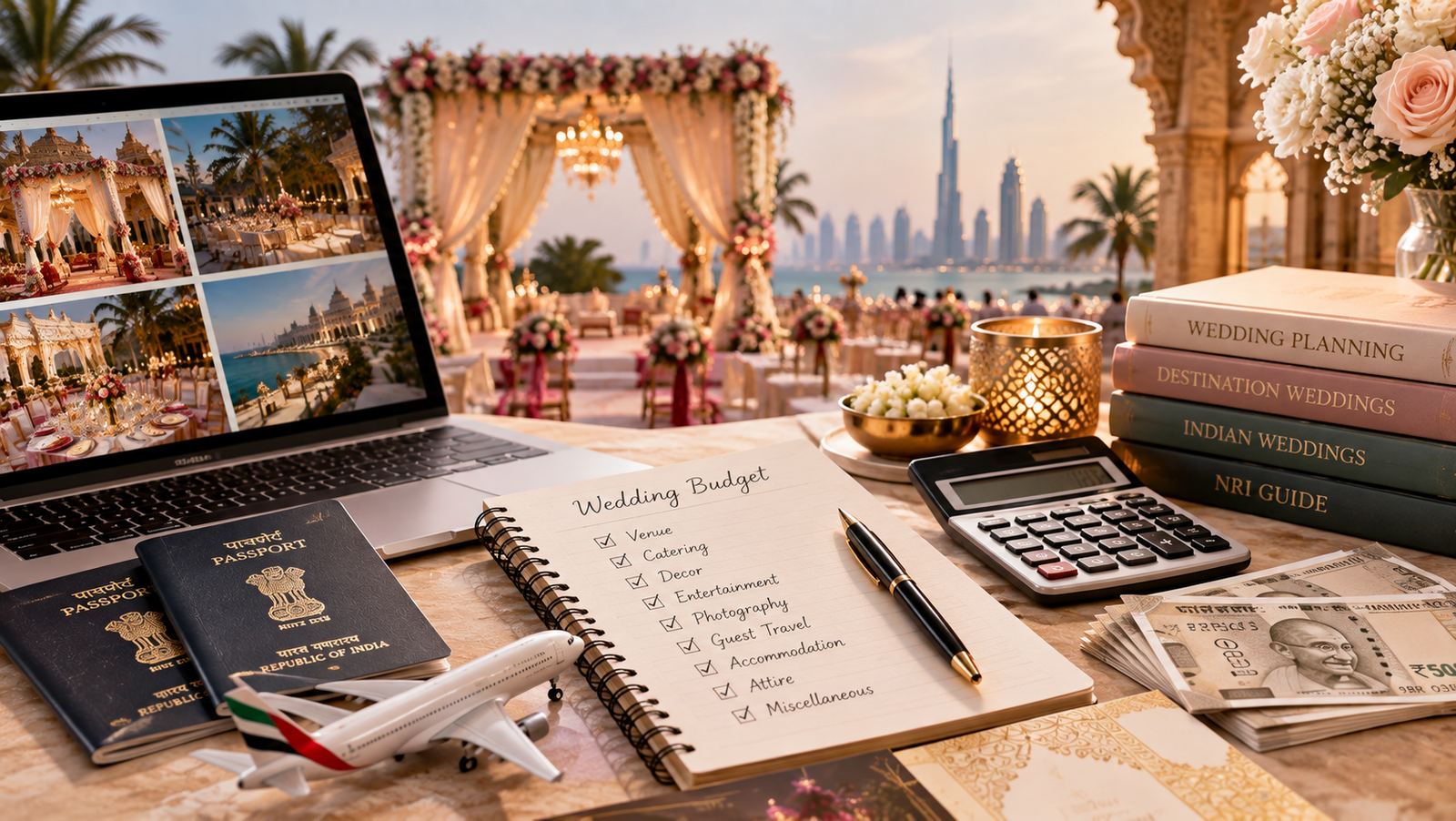
A wedding budget becomes more complex to manage when the couple is planning the event from overseas. Currency conversions, international travel and accommodation, taxes, vendor payments and multiple celebrations can all put a strain on the numbers. It is not necessarily a case of spending less but understanding where the money is going and deciding how best to spend it.
Create a broad budget before approaching vendors that takes into account the entire wedding experience rather than just the ceremony. Accommodation and venue costs will often make up the largest chunk of the budget, particularly for a destination celebration. This is then followed by catering, décor, photography and videography, entertainment, attire, beauty and styling, transportation, hospitality and event production. For couples investing in a luxury wedding planner in Chennai or elsewhere in India, the need for professional planning and execution needs to be taken into account from the beginning, rather than as an afterthought. It is useful to split these budgets into essential, experience-enhancing, and optional categories so that decisions can be made more easily when quotations arrive from multiple vendors. Make Sure you have a contingency budget. Contingency funds are particularly useful when working remotely. A last-minute transport requirement, extra guest accommodations, weather changes, production adjustments, or a vendor requirement that was not anticipated during the initial planning can all add up to unexpected costs. International couples may also have to take into account currency fluctuations between the establishment of their budget and when final payments are due. A sensible contingency amount gives the planning team the room to resolve problems without turning every unforeseen expense into a crisis. It also provides something a little less tangible but equally as important: peace of mind.
Luxury is often confused with quantity. More flowers, more installations, more entertainment and more detailed elements do not always equal a more luxurious wedding. For an NRI couple, thoughtfully spent money really can make all the difference. Investing in comfortable accommodations, seamless transport, excellent food, well-managed entertainment and attentive hospitality can transform the experience of their guests. So too can they consider Indian wedding décor, beautiful lighting and carefully selected music and details that reflect their story. The aim is to create an elevated Indian wedding experience rather than simply an expensive-looking one. This distinction becomes particularly important when planning a multi-day celebration. Rather than making every function equal, couples can give each event its own unique character. A relaxed welcome dinner might focus on conversation and local cuisine; the sangeet can be more energetic and lavish, while the wedding ceremony can return to the cultural heart of the celebration, followed by a reception that introduces a more contemporary visual language. For couples considering the option of NRI wedding planning services, this is one of the areas where an experienced planning team can add real value. A good planner will not merely offer you options and then help you decide based upon their perceived value. They can advise you on which choices will serve your larger vision and where the budget can work harder. The most successful budgets are therefore not necessarily the largest ones. They are the ones that understand what the wedding is trying to say and spend accordingly.
The thing most couples find most challenging about NRI wedding planning services is the uncertainty of things getting done their way. It is not the decision-making that gets to them, but rather the inability to control the process. The timing of the venue visit is slipping, the meeting with the vendors falls outside working hours, and approvals take forever to come through. This is why remote planning requires structure, transparency, and one competent team on the ground.
When multiple vendors communicate separately with the couple, it creates a distorted picture of what is going on. The production team may have decided to tweak the décor based on one conversation, whereas the transportation service was not informed that the guest accommodations will be changing. Someone has to have an integrated view of the planning process at all times. You can do this by designating a shared project management tool where timelines, budgets, vendors, guest lists, décor ideas, and all other project details are stored and updated. All significant decisions should be documented there with ticked-off approvals, notes for further discussion, and action items. It will be much easier for an NRI couple to stay on track, especially since they may not have someone local who can oversee things in person.
The difference between a competent and incompetent wedding planner in India is often their experience with overseas clients. First and foremost, your contact should be able to communicate clearly and confidently without using jargon or being unclear about time zones. A reliable NRI wedding planner will understand that it is normal for the couple to miss one or two video calls, have limited time to review documents, and be unavailable during their local nighttime. Second, they should know how to advise you on matters that require a local touch, such as venue visits. You cannot expect to explore three places in one day as an NRI couple, so you need someone to advise you on which options to pursue. Their job is to help you make educated decisions on all things wedding-related, removing guesswork from the process. You should never have to research red flags and deal-breakers yourself if you can get competent advice from your planner.
There is a big difference between being informed and being in charge. As an NRI couple, you should not have to worry about the day-to-day details of your wedding. It is one thing to decide on the colour scheme and approve the final floor plan in advance, but it is another to stand by the mandap while it is being built and ask the staff if your favourite table is set up correctly. You may think that your involvement is necessary, but it is better to work with a professional execution team that can handle all aspects of the wedding as if it were their own. That is why Oh Yes Events is the right NRI wedding planner for you. As a premier event management company in Chennai, we perform all aspects of local wedding planning while leaving you free to enjoy the process. You will only have to make important decisions regarding your big day, trusting the experience of our team to handle the rest.
A well-structured approval process can save you months of unnecessary stress. It is better to batch your requests together so that you can review and approve them in one go than ask vendors to update décor samples or the menu repeatedly. You should receive a single message with project updates and questions at predetermined times, rather than dealing with multiple vendors asking individually for your feedback. This way, you can avoid the most stressful part of wedding planning—decision fatigue. When everything is presented to you in an organized manner, it is much easier to focus on what matters. You do not have to sift through irrelevant information or deal with vendors asking too many questions. A good planning partner will be able to do that for you, presenting you with only the final proposals and solutions. The final approval process should be much simpler, helping you avoid last-minute surprises.
The most memorable NRI weddings tend to be those that do not feel as though two ideas have simply been placed next to each other, which do not look like an international luxury wedding with a few Indian elements added at the last minute. Instead, the best celebrations can be ones in which contemporary design, personal taste, and culture coexist within the same visual language.
Luxury need not mean the removal of cultural details; in fact, some of the most distinctive wedding environments are those that integrate Indian craftsmanship into contemporary design rather than utilize it as decoration. Handwoven textiles, regional embroidery, brassware, traditional metalwork, artisanal ceramics, carved wood and locally-sourced materials can bring a sense of place without creating an overly traditional setting. The same principle can also be applied to modern Indian wedding décor. A mandap does not need to be swathed in layers of ornamentation to feel culturally significant; it could instead incorporate restrained floral arrangements, architectural elements, natural materials and thoughtfully placed lighting without ever losing the visual language of the ceremony. The result is a wedding that feels Indian without cliché.
For couples who have grown up between cultures, traditions can sometimes come with complicated feelings. Some rituals may be deeply meaningful; others may feel unfamiliar, as they were not part of their lived experience. This is completely normal. A meaningful cultural wedding experience does not necessarily require couples to perform traditions exactly as per previous generations. A couple can choose to understand the roots of a ritual, decide what resonates with their experience, and find ways to include family members in it. This approach can also be really beautiful in a cross-cultural wedding, as both sets of family traditions can be incorporated for guests who may not have witnessed any part of them before. It may look different for international guests, but some level of explanation can help turn a ritual that was unfamiliar into a memorable experience. It can be as simple as a ceremony programme or a brief mention by the emcee or having the family help explain a ritual.
Global luxury tends to be less concerned with a certain aesthetic and more with the presence of restraint, detail and consistency. A couple may want a refined colour palette as opposed to a riot of hues, sculptural floral arrangements as opposed to garlands everywhere, minimalist stationery which makes subtle references to Indian motifs, and tablescapes which have contemporary forms but utilize regional materials. Lighting that creates atmosphere without overwhelming the architecture. It is in these places that traditional wedding décor and modern design need not compete. A traditional element made even more powerful by its placement within restraint. A centuries-old motif can be reproduced in subtle ways across stationery and menus, rather than being enlarged across every surface. A regional textile can be the inspiration for a table runner, or local flowers can be sculpted into an installation, rather than a conventional floral wall. The presence of cultural Indian elements in a globally inspired luxury wedding is not about minimizing its impact, they are about making its presence feel more considered.
A wedding should also respond to where it is taking place. A coastal celebration might pull more from the landscape, textures and flora; a heritage venue may want design that complements its existing architecture rather than trying to obscure it; a celebration in Chennai can incorporate South Indian visual cues, materials, food and hospitality while still utilizing a contemporary luxury aesthetic. This is about allowing the Indian wedding culture around a celebration to become part of its identity. The international lifestyle of a couple can shape the aesthetic, but the location will provide the context. This is what makes a destination celebration feel authentic rather than interchangeable; guests should be able to remember not just how beautiful the wedding looked, but where they were and why the celebration could only have happened there.
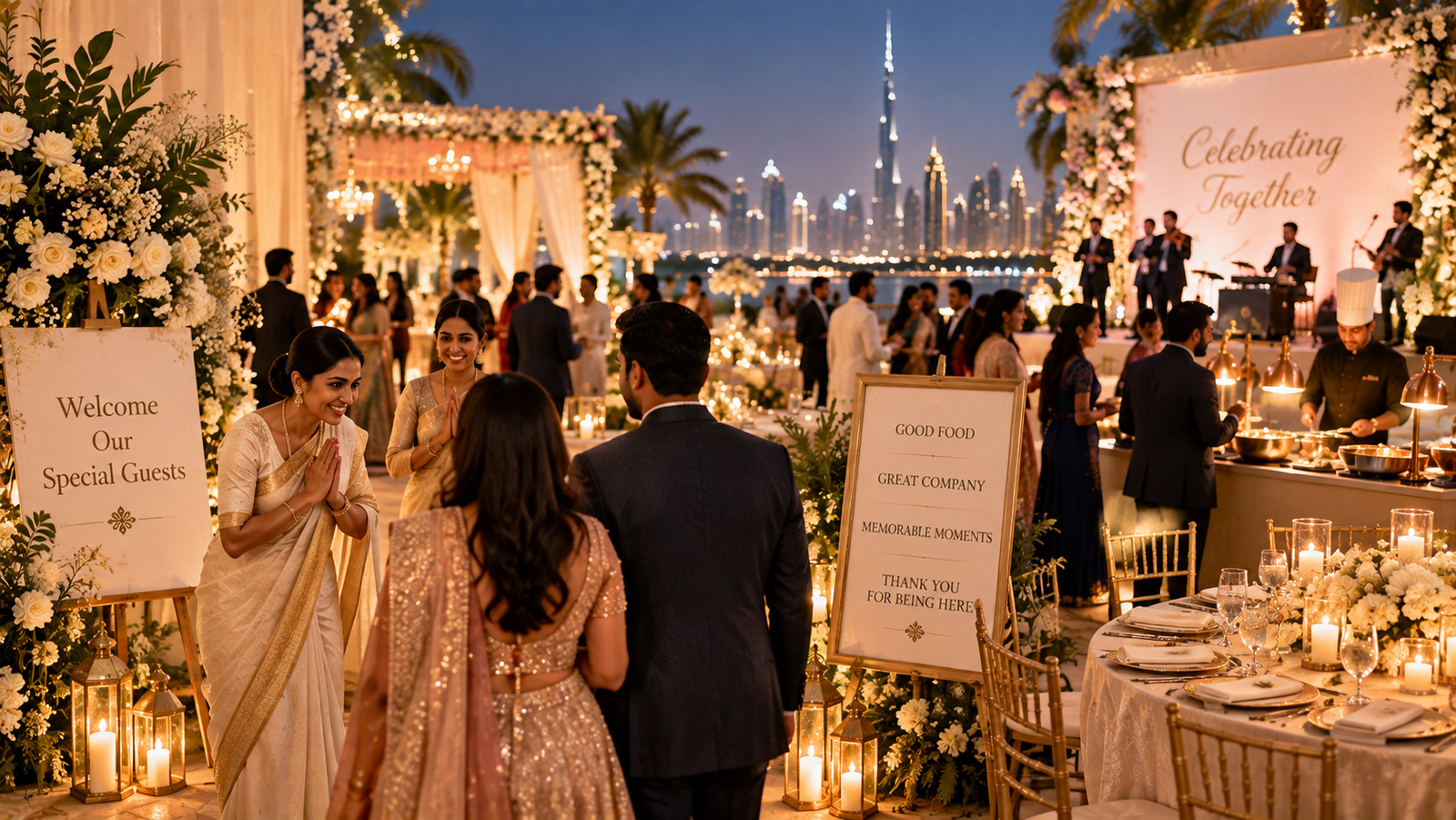
The guest experience for an NRI couple's wedding starts well before arriving at the venue. Imagine if you are flying in from another country, on separate flights, with stops on the way. Once on site, the wedding itself is a celebration, but a welcome is a transition: an adjustment to the unfamiliar.
Travel is an important factor when managing guests for an NRI couple's wedding. They (or their guests) may arrive on site at different times and from different places. Guests may need airport transfers or may choose to extend their travels to visit the location before or after the event. Senior guests may require more comfortable transport, while families with children may need accommodation and planning that suits their needs. The planning of accommodation becomes intertwined with the venue. It is preferable to have the guests travel together, if not always stay in the same venue or adjacent hotel. Having guests travel between functions on site or within the same building allows natural exchanges between guests, which is good for interaction. A guest tracker may include details regarding arrival and departure, room allocation, special needs and personal preferences, transportation and emergency contact information. While this might seem laborious, it all comes together on the day.
A welcome provides orientation but should not overwhelm. A welcome kit may be prepared with a personal message, information on schedules, local treats, useful information on location and emergency contact details, transportation details, etc. For an international guest, the latter may be particularly helpful. At first glance, this sounds like an organization. Behind it is the quality of Indian hospitality: to anticipate the needs of the guest. The welcome also acquaints the guests with the location. Part of hospitality also includes presenting local produce or cuisine and explaining the peculiarities of local culture—but made light and accessible. The idea is not to dictate to the guests but to make them feel that they have been personally invited.
Indian weddings are wonderful experiences, but they can also be long, busy affairs for the guests. To a foreign guest, they can also be perplexing: unfamiliar rituals at confusing times, with uncertain expectations of participation. Appropriate seating, hydration stations, a comfortable climate, clear schedules, and accessible information on the proceedings or on-the-spot translation services can ease anxiety for guests unfamiliar with the event. Where appropriate, an explanation of the significance of different parts of the event can be given without overshadowing its romance. A similar courtesy is extended to the guests of the couple getting married: parents and grandparents and children and guests with specific needs. An effective guest management strategy for an Indian wedding considers the needs of different types of guests, from senior citizens to families with children, rather than a homogeneous mass of people with a single set of requirements.
A multi-day Indian wedding is not a series of functions on the same site but a cumulative experience. The welcome dinner may set the tone, the mehendi provides a relaxed affair, the sangeet a lively music session, the wedding ceremony reverts to time-honoured traditions, and the reception takes on a more modern feel. The events are connected at every stage by a strong thread of Indian culture and hospitality, but each can provide different types of experiences. This is an advantage to an NRI couple: having guests travel from afar to be part of the wedding is a priceless experience for the couple saying goodbye to their home country. The wedding is not only an event but also a cultural experience, as well as a place for relatives, old and young, to connect. Good guest experiences rarely originate in one dramatic moment. Rather, they are the product of hundreds of everyday moments coming together in harmony. Coordinate Vendors, Décor and Entertainment Under One
A wedding can have an amazing florist, talented photographer, incredible caterer, and brilliant entertainment and still not feel united. Not unified, not joined together, not cohesive. Because there is no one singular vision that coordinates the services of each vendor to create a wedding that reflects one big idea. And for couples who plan the wedding from overseas, this one singular vision becomes even more important since they can't be there to sort out overlaps or conflicts in the planning.
The first step is not finding as many vendors as possible but finding the right mix of vendors that will be able to execute your wedding vision. Depending on your wedding, this can mean the venue, catering, décor, photography, videography, entertainment, makeup and styling, transport and production vendors. Each vendor has to understand their place in your wedding and how they can contribute towards your big day. For instance, the photographer must know about family milestones and important rituals, the décor team has to know the production requirements, the entertainment team has to know the timing, the catering team has to know about traffic and flow of guests, and so on. That is the difference between random vendors and a stellar team of wedding planners.
For instance, the visual design of the wedding has to bleed through into other elements in the wedding, not just the décor. Invitations, signage, menus, table settings, flowers, centrepieces, lighting, and venue can be part of one singular visual language without being exactly the same. This is important if the couple wants to mix and match very different design styles. You can have a traditional mandap that takes its inspiration from centuries-old rituals but with modern lighting and restrained floral decoration. You can have a reception that interprets the same palette and materials in a completely different setting. Similarly, for the Indian décor, you can have a strong local regional aesthetic with traditional materials without being overbearing. The trick is to repeat elements (colour, texture, pattern, material) throughout the wedding in different formats.
Entertainment too has to be curated in the same manner for the couple. Instead of asking what is trending, find performances that would fit the mood and vibe of your event. A classical Indian singer can be exactly what you need for the evening reception, while a DJ can provide the right soundtrack throughout the sangeet night. While a cultural performance can introduce an international audience to a local art form, a family performance can become an intimate and memorable highlight of the wedding. When it comes to a fusion Indian wedding, the performances can become an interesting way to conflate different cultures without segregating them. That same approach can be applied to production with lights, sounds, and effects. The idea is to create a certain experience and not to overpower the event with larger-than-life spectacles that have no bearing or context.
Finally, this is where wedding management planning becomes crucial. If you are using multiple specialists for your wedding, someone has to understand the bigger picture, know how to coordinate everyone seamlessly, and keep things running. Who has priority at the venue? When does the décor team arrive? When does the photographer come in? When can the sound check be done? When does catering pitch in? When does the stage change? These questions, while invisible to most guests, have to be answered with precision. Because if not, things will visibly turn chaotic. For an NRI couple, this is even more important since there is only one team to answer to, not multiple. The end goal is to let the couple enjoy their wedding while the wedding machine takes care of the rest.
One of the easiest ways to start managing NRI wedding planning in India is to take the wedding week off your planning responsibilities. By the time you reach your destination, the hard choices should have been made, the vendors should know their roles, and the guests should not have any questions. The wedding week should focus on being in the moment and enjoying the fruits of your labour rather than putting out fires.
For a big destination wedding celebration, you want to give yourself plenty of time to make smart choices. Start by setting an estimated guest count, budget, and desired wedding dates. Next, prioritize the locations and venues you and your partner would consider based on travel time, lodging and the number of functions you wish to hold. This is also a good time to hire a planner, if you haven’t already, so they can start developing the wedding strategy with you—especially if you’re considering NRI wedding planning services. Once the venues are set, it’s time to start designing the rest of your wedding.
At this point, it’s time to start shifting from strategic planning to production. Finalize your big vendors like décor, photography, videography, catering, and entertainment. Begin developing the design direction and set the tone for each of the celebrations. Guest accommodations and travel arrangements should be in order by this point, and it’s also a good time to start formalizing the Indian wedding rituals that are important to you and your family. Your families should have an understanding of the requirements for each wedding ceremony and celebration well ahead of your wedding week. For couples who are planning cultural destination weddings, this is especially important so guest accommodations, production, and other logistics can be built around the cultural elements rather than adding them in at the end.
As you near your wedding date, everything should start coming together with little room for surprises. Your guest list should be finalized and rooms blocked, airport transfers and transportation arranged, menus approved, entertainment scheduled, décor installed and production requirements finalized. If you’re an NRI bride and groom, this is when the planner can start compiling the information that would normally come out of dozens of panicked conference calls. A printed master schedule is a great way to do this so you can see everything at a glance. This should
This should include
before your big day.
This should include
before your big day. Wedding Week Ideally, your wedding week should pass without incident. Guests will arrive and depart according to the detailed wedding timeline, rooms will be ready when guests need them, installers will finish setting up the décor and entertainment you selected, and each part of your wedding will have someone in charge making it happen. The couple will still have decisions to make, but nothing that requires much time or thought. They’ll still have a big day full of activities to enjoy, but they won’t have to worry about whether the production crew has arrived or whether your 40-person bridal party has shown up. This is the point where the difference between planning and execution really matters. A great vision doesn’t mean much if it can’t meet the demands of the real world. Experienced wedding guest management, vendor coordination, and production supervision can make the difference between a beautiful vision and a beautiful memory. For couples who are working with a destination wedding planner in Chennai or an event team that’s helping them host a wedding in another city in India, this is all part of the process. The timeline should exist not for the planner to keep on their computer, but to share with the couple so they can see what makes their vision come together.
By this point, the practical requirements of an NRI wedding have been established: there is a venue to reserve, a budget to stick to, guests to accommodate, traditions to learn about, and a design vision to execute. But what connects all these elements together is the planning partner. This is especially true for couples overseas, for whom finding the right team means the difference between a stress-free celebration and a year spent wrangling the people they've hired.
While a lovely portfolio is always a good start, it doesn't always say everything about how a planner works. Instead, ask about their planning process, communication hierarchy, vendor network, and approach to destination weddings. But more importantly, discover if they understand what it means to balance attractive weddings and complicated logistics. For NRI couples, in particular, a planner with international experience will be an asset. They should be able to understand what you want and translate it into what can be delivered at a specific destination—in terms of both budget and available resources. Someone with an eye for aesthetics will add value, but a planner who understands Indian wedding traditions and the differences between communities will be a real find. That brings us to the next important consideration for NRI weddings.
An important question to ask any shortlisted planners is who will be present on the wedding day. The person who pitched their proposal might not be the one to manage the execution, so ask who will be looking after vendors, supervising vendors, family managers, guest coordinators, and so on. This is especially important in the case of NRI wedding guest management, where international guests might be expected to attend multiple events across the wedding day and turn up at different locations and on different days. Find out how they propose to manage the complexities of an NRI wedding, including what their disaster recovery plan looks like. Ask to meet the team and how they propose to communicate with you as the bride and groom—who may be overseas on the wedding day.
An end-to-end planning partner should be able to view the wedding as a single ecosystem, rather than a collection of disparate needs to be ticked off a list. That means looking at the big picture of a luxury destination wedding while still being able to execute the details of décor, venue, production, catering, events and guest management. This is especially important for an NRI couple, who may not have the time or presence to manage multiple vendors on the ground. Oh Yes Events applies this end-to-end ethos to every luxury event it manages in Chennai as an elite wedding planner in Chennai, drawing upon a deep well of experience with Indian weddings to create elegant, sophisticated celebrations. But a planning partner should be able to leave space in the process for the bride and groom's personal touch, applying their own unique personality to every element of the wedding.
At its core, an NRI wedding requires a particular type of translation. The couple might have a global vision for their big day, but the planner will have a deep understanding of the local culture, nuances, and available resources. In the best cases, these two forces combine to produce something more interesting than either could have created alone. That's why choosing the right planning partner is less about finding someone who can simply execute your wishes and more about finding someone who can interpret them. You will likely be thousands of miles away from the wedding, making it important to have someone you trust and can communicate with easily. After all, the beauty of a destination wedding is supposed to be that you can enjoy it, rather than spending months preparing for it. The ability to explain your vision from afar and have it understood on the ground is the hallmark of a true luxury NRI wedding planner.
The NRI wedding in India does not have to choose between international luxury and cultural authenticity. The best weddings find a way to create space for both—the refined but familiar and the genuine expressions of family, home and tradition. The secret is in the planning. By choosing your destination wisely, managing the vendors, looking after the guests and integrating Indian wedding rituals in due order, you can give your celebration a sense of occasion, as well as the warmth and belonging of home. For couples planning from overseas, the right team can go a long way in finding that balance. Oh Yes Events offers planning, design, production, hospitality and on-ground support as a premium event management company in Chennai, enabling couples to turn their idea of an international wedding celebration into a uniquely personal experience. Whether you are thinking of an intimate ceremony, a multi-day affair or a destination wedding with guests flying in from far and wide, the objective remains the same—creating an experience in which every element has been considered, and nothing feels unnecessary. Because your wedding in India should not feel like another project you had to fly home for. It should feel like coming home.