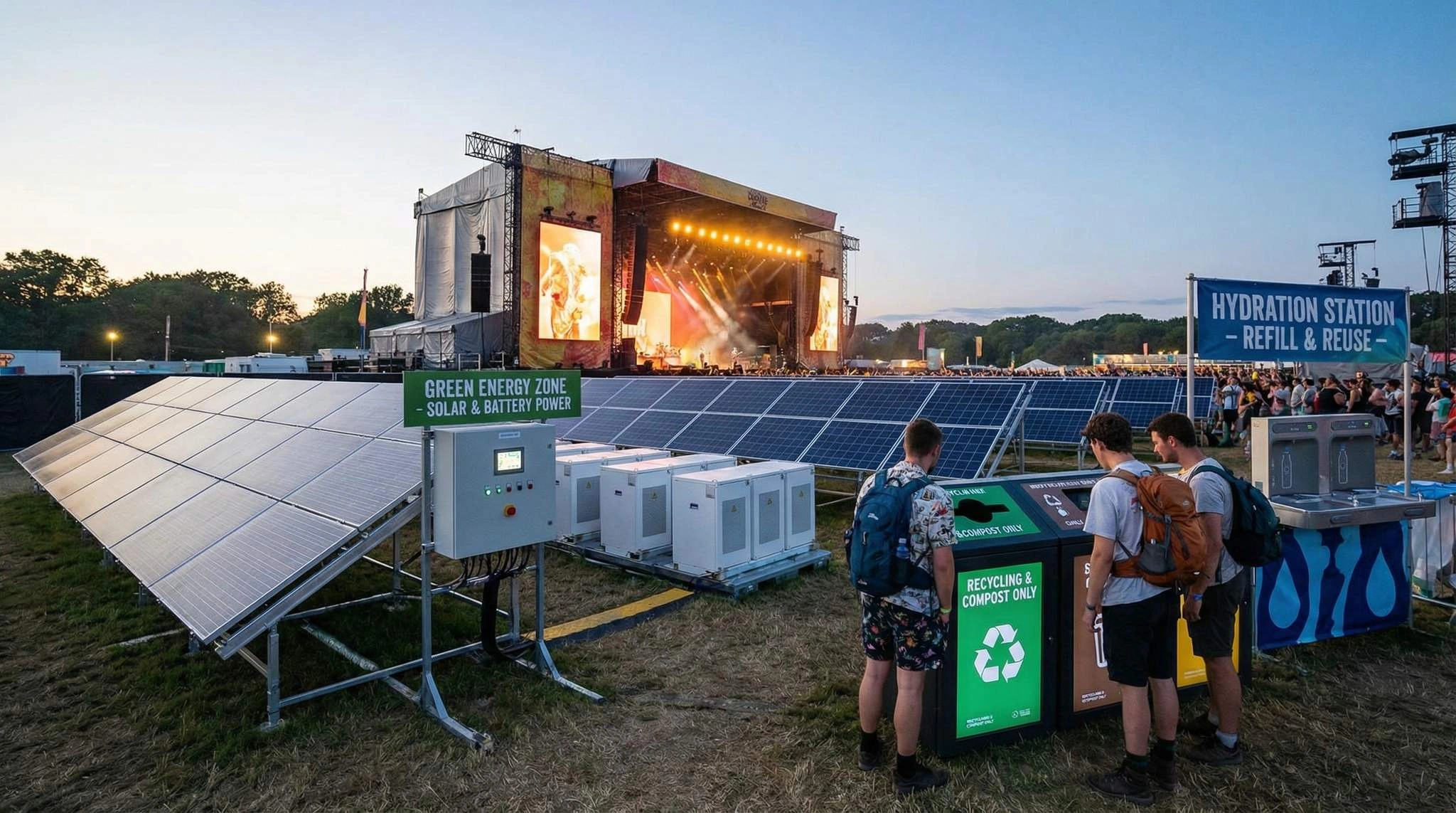
There is a change in the events landscape, and it is more than just a cosmetic or a numerical change. If you have been paying attention to the way in which the largest events on the planet are being planned and fueled, you will have noticed that there is a quiet revolution happening, and it is fueled by a very different kind of renewable energy. In fact, a very literal one.
In 2026, the question is no longer whether or not your event needs a sustainability plan. It is a question of just how seriously you are taking your sustainability plan. At a macro level, the 16th IRENA Assembly kicked off 2026 with a bold mandate to accelerate the energy transition to renewables and international cooperation. And that mandate is leaking into event briefs, vendor contracts, and venue policies in a very rapid fashion.
What we are seeing play out at the moment, across stages, festivals, and corporate events, is the practical implementation of the decarbonization goals. Large governing bodies, such as the World Athletics organization, have already introduced regulations that require the implementation of carbon reduction strategies, focusing on the areas of energy and travel. And what we are seeing, particularly from the side of the event organizers, especially at scale, is that the move towards solar-powered stages and the like, as well as the implementation of HVO biofuel, isn’t a disruption; it’s a relief. It makes the narrative we want to present a lot simpler.
We, at Oh Yes Events, have been watching all of this play out, and we thought we’d write this blog as a way of making sense of all the technology, the practical implementation, and the future of the events we love.
The world we face as we plan renewable energy events in 2026 is no longer simply about guilt or good PR. The geopolitics, the volatility of oil prices, and the impacts of climate change have all come together to make the fossil fuel supply chain a risky business. As IRENA clearly outlined at their assembly, the energy security of nations is becoming increasingly at risk, and that includes the risk to the operations of large-scale events relying on diesel generators.
Of course, there are some differences when you fast-forward to 2026. The industry has finally moved beyond the vision board. Sustainable event planning used to mean buying some carbon offsets and printing on recycled paper. Sustainable event planning now means evidence-based delivery. In fact, the updated guidance from the World Athletics carbon neutrality strategy clearly states the following: Organizers must provide evidence of the following: carbon projects supported, clean technology used, and low-carbon transport solutions used.
That's not aspirational. That's accountability. Organizers are being asked to provide a briefing to local committees on the climate commitments, including clauses on carbon monitoring as part of the vendor contracts, working with the host city to leverage the existing grid modernization infrastructure, and more. The result is a market where net-zero events are no longer the exception but rather the norm.
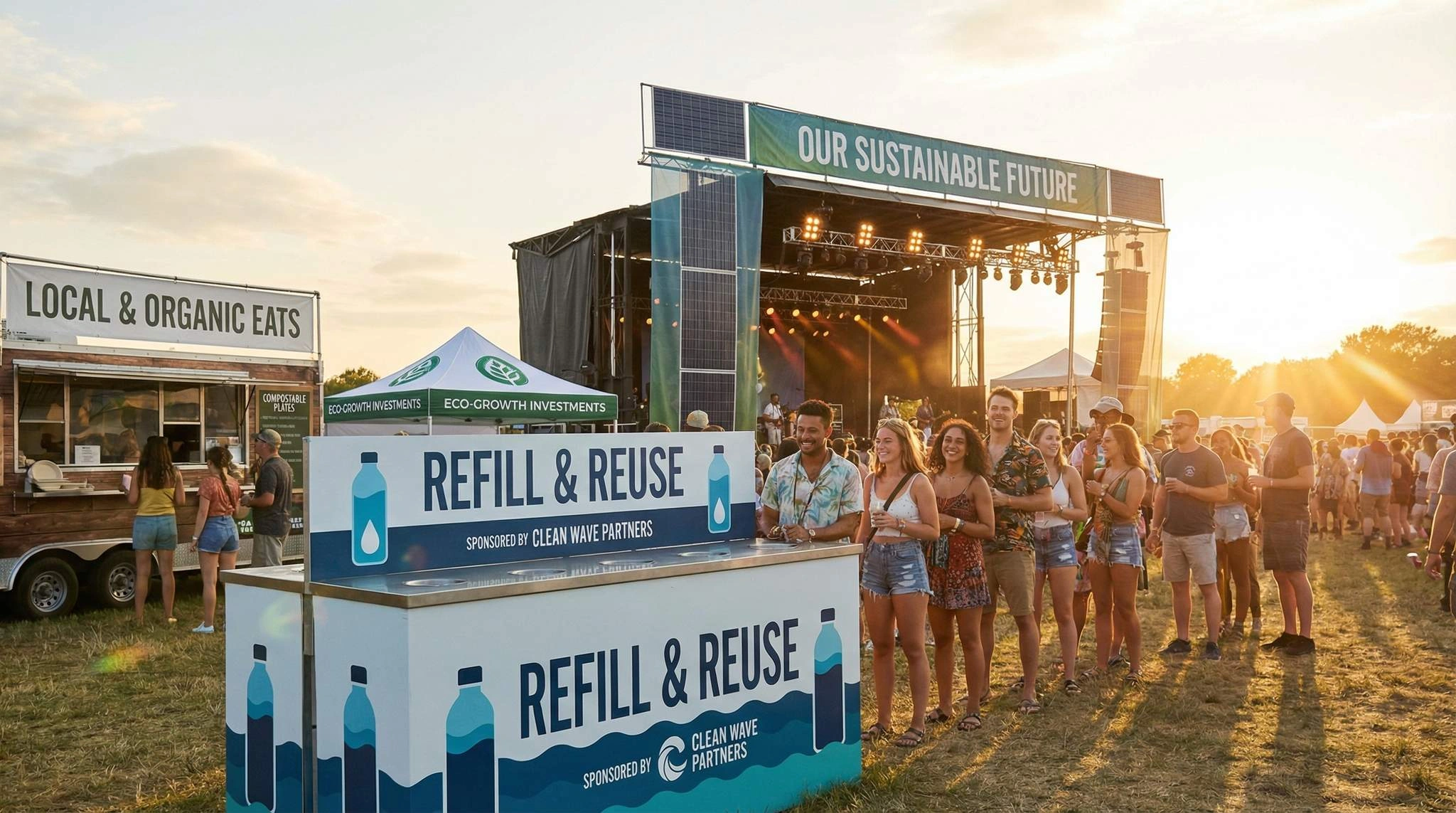

Numbers are important, and they're even more important when you're trying to persuade people to invest in change. So, here are a few numbers that are significant and have a material impact:
If you're still on the fence about the large-scale events' sustainability, these numbers should be fairly compelling as a counterargument. Clean tech is not just the right thing to do; it's the rational thing to do as well.
Let's discuss what is available in the here and now. And I assure you, the state of the art for event organizers in 2026 is really quite impressive. It is no longer a prototype. It is no longer a "we hope to get to that someday" situation. It is here. It is real. It is working.
The traditional drawback of solar for events was, of course, intermittency. What do we do when a cloud comes over the sun in the middle of a set? Well, we no longer worry about that. And that is because of storage. And we are seeing that in play in The Stage Box Mini. It is a small, all-in-one solution that includes a solar-powered battery solution that provides eight hours of continuous power. That is a full day of power on a solar panel without ever needing a generator.
But perhaps the most exciting part of all of this is what is happening in storage. Modular Battery Energy Storage Systems, or BESS for those who want to use a little jargon, are a solution designed specifically for events. The result is something that, only a decade ago, would have been considered impossible: microgrid technology for events that really does minimize reliance on noisy, polluting, and expensive diesel generators. And for events outside, this is a revolution, both in terms of environmental impact and in terms of the overall experience.
So, if you're ever wondering how to power a festival with solar energy, the honest answer in 2026 is: it's not a question of if, it's a question of how. Solar and storage can now provide base load for stages, vendor villages, lighting, and much, much more. The technology is there.
But let's talk about what is available in the here and now. And I can tell you, the state of the art for event organizers in 2026 is really quite impressive. It is no longer a prototype. It is no longer a 'we hope to get to that someday' scenario. It is here. It is real. It is working.
But not all applications can be powered by solar power alone. There are major stages, large-scale catering operations, and high-demand infrastructures that need to be powered by high-output energy. And that is where advanced biofuels have come in and really made a difference.
Tomorrowland Winter 2026 is said to be the new benchmark for festival energy consumption. All production transport for the build and break of the festival will run on HVO biofuel for events. And that is said to have reduced production transport emissions by up to 90%. It is a figure that can stop a room in its tracks.
But for the Milano Cortina 2026 Olympics, a specialist "arctic" HVO diesel fuel was developed to operate in temperatures as low as -28°C. Snow groomers and electricity generators—all running on a fuel that is derived from renewable sources. It is not just a victory for the environment. It is a victory for temporary energy solutions for outdoor events that can operate in the most extreme of conditions.
Sourcing cleaner energy is one thing. Managing energy in an intelligent manner is another. The most forward-thinking operations in 2026 are doing both, and the key to this is AI.
In fact, at the Energy Storage Summit 2026, there was a discussion about how hybrid power plants and AI stability modeling were revolutionizing energy management. In the case of events, this means something quite useful and powerful: simulation tools and intelligent inverters that can predict energy demands before they peak and then adjust energy supply accordingly.
It means not a single watt of energy goes to waste. And in an industry where energy is a substantial expense, this is not only good for the environment, it's also good for the budget.
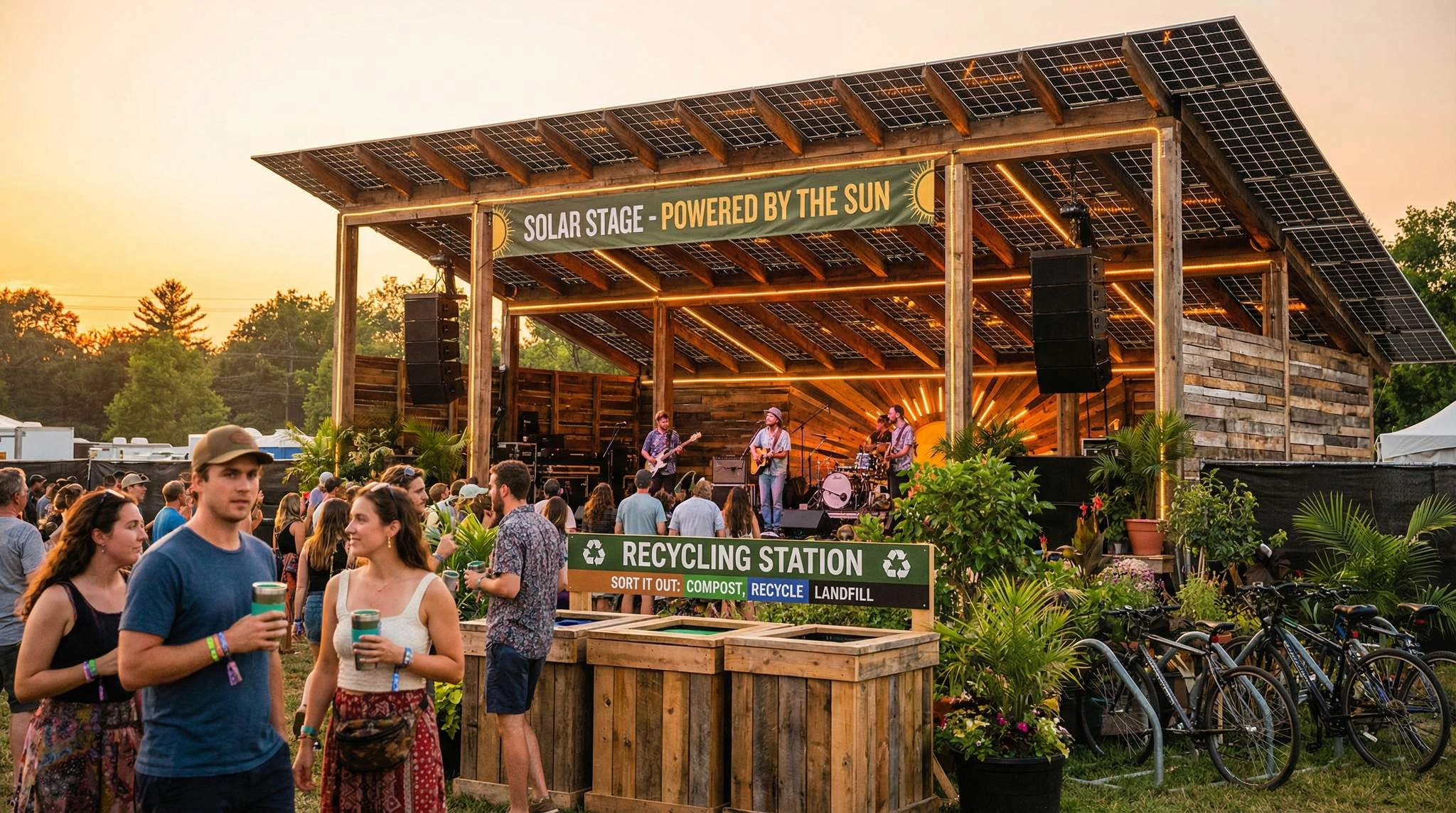
Theory is great, but examples are even better. While the discussion around sustainability might still be quite theoretical, pioneering event planners have already shifted their focus from planning to execution. The following is a glimpse of what green energy in festivals and in the world of international gatherings looks like when renewable energy strategies are successfully implemented.
The sustainability case study of the Milano Cortina 2026 Olympics might be the most frequently cited in the world of sustainable event management this year—and for a reason. The sustainability strategy of the organizing committee is based on a single word: minimize. The fuels used in the games are comprised of more than 90% renewable energy sources. The 250 electricity generators are fueled by HVO diesel, which leads to a 70-80% reduction in greenhouse gas emissions in the process.
For an event of this logistical scale, with various locations, diverse climatic conditions, and infrastructure requirements, such a level of decarbonization is quite remarkable and proves that the scale of the event is not a reason to be concerned but rather an opportunity.
Festivals have always had a slightly wilder spirit to them, and Tomorrowland's "Love Tomorrow" initiative is showing that this spirit can extend to their approach to energy strategy as well. Their Mainstage is powered by HVO fuel, and they have replaced their diesel generators with a fixed power network across all stages. The outcome? 387 tonnes of CO2 savings, which is the equivalent of over 3,500 car trips between Paris and Alpe d'Huez.
They have also installed 90 high-end waste sorting systems across the festival site. The idea of the circular economy events is no longer just something to talk about; it's something to operate. It is great to see entertainment and the environment working hand-in-hand.
In addition to the temporary infrastructure of the event, the permanent infrastructure is improving the basic infrastructure of the venue. With the roll-out of large-scale BESS, as has been discussed at the Energy Storage Summit 2026, venues are now able to manage the way they handle their energy more intelligently, reducing the need for the grid during peak event times.
Renewable energy certification for events is becoming more common, and it is appearing as a standard requirement of the venue contract. I-RECs, or International Renewable Energy Certificates, are becoming the language of proof, the way a venue can credibly claim that they are using renewable energy. In the next few years, these certificates are going from being a nice-to-have add-on to becoming a minimum requirement of any venue that wants to claim itself as 'green.'
We'll be honest with you: all of that is genuinely complicated. The tech is changing, regulations are getting more stringent, and client and audience expectations are increasing all at once. And that is precisely why we, as the best sustainable event planner in Chennai, are as relevant as we are today.
We do not believe that sustainability should detract from the experience, not from the spectacle, not from the emotion, and not from the music. What we do believe is that it requires a genuine effort in terms of planning, vendor relations, and a genuine understanding of the tech to do it correctly. And we have all three.
As the best green event management company in India, we can help clients develop event carbon reduction strategies from scratch, not as an afterthought. Whether we are working on a corporate event that requires certified renewable energy purchasing, a music festival that requires solar and battery technologies, or a large-scale outdoor event that requires a comprehensive approach to reducing carbon footprint at music festivals, we have experience working through all of these challenges.
As an eco-friendly corporate event organizer Chennai trusts, we apply global best practices, the Milano Cortina template, and the Tomorrowland blueprint to our work on the ground. Our carbon-neutral event planning services in India are grounded in the same data-driven, evidence-based delivery approach that's now being mandated worldwide and will be required for all events under the auspices of the newly formed World Athletics. And our renewable energy event solutions Chennai companies count on are informed by the actual technology available today, not the technology we hope will be available someday.
At Oh Yes Events, we help you tell your sustainability story in a way that's credible, measurable, and genuinely worth telling.
If 2026 is the year of demonstrating that sustainable events can be scaled, the following years will be the time of ensuring that sustainable events are the only way events can be delivered. This is because, as regulatory force increases and technology costs come down, the era of experimentation with sustainable event planning is over. This is what we expect to define the way forward.
As the fuel gets cleaner and cleaner, the focus shifts to everything else: the materials we build our stages with, the merchandise we sell, and the food we serve. The Science Based Targets Initiative (SBTi) is now even suggesting different ways of dealing with Scope 3 emissions events, which include the upstream and downstream emissions of our events, i.e., our supply chain and the travel of our attendees.
And this is where the circular economy events model comes into play. Not only will events be judged on the fuel we use, but also on the fuel we use for the entire lifecycle of every single material we use. Staging designed for disassembly and reuse. Signage created from reclaimed materials. Catering with zero single-use plastics. It's a holistic view of our events, and it's on its way.
Credibility is going to require verification. As standards become more stringent, policy instruments and verification frameworks are going to become increasingly more important. I-RECs are already becoming standard practice for venues, and in the coming years, we're going to see more stringent regulations around events verifying their energy sources through audited, third-party methods.
What we're going to see in best practices for sustainable corporate events in 2030: Disclosure around energy sourcing, verified carbon accounting, and supply chain transparency are going to become standard practice. If you're forward-thinking and start building these types of relationships and infrastructure now, you're going to find it relatively painless in five years. If you're not, you're going to find it to be quite expensive.
On the technology side, AI-enabled microgrid management and simulation are going to become standard practice, rather than differentiators. Hybrid power plants using solar, storage, and biofuels in optimized AI-managed packages are going to become the new normal for powering events. The question won't be how to deploy these types of technology, but rather what works best for your specific application.
Somewhere in the space between the math and the momentum, something has become clear: renewable energy is no longer just part of the modern large-scale event. It's the foundation. From the Alps to festival sites in Asia and Europe, the story is being written over and over: green energy for festivals and events is no longer a trade-off. It's an upgrade. Cleaner energy, better resource management, better energy management, and people who see it, hear it, and care.
The technology exists, the case studies are out, and the regulations are coming in. And for those of us who believe that live experiences are important, that there is joy in being part of a crowd, part of a shared experience. At Oh Yes Events, we power it right, or we lose our right to power it at all. We're not waiting for 2030 to become a thing; Oh Yes Events, as a recognized top green event management company in India and your partner in sustainable event planning, is already building events based on these principles—one solar battery, one HVO generator, and one verified carbon plan at a time.
If you're ready to make your next event something the planet can also celebrate, we'd love to talk